



manganese nodule
Manganese nodules, also known as polymetallic nodules, are solidified products of seabed rocks, produced by the solidification of iron or manganese hydroxides in a core. Its core may be extremely small and may completely transform into manganese minerals due to crystallization. When manganese nodules are visible to the naked eye, they may be small microfossils (Radiolaria or Foraminifera organisms) shells, phosphorylated shark teeth, basalt remains, or fragments of early solidified material.
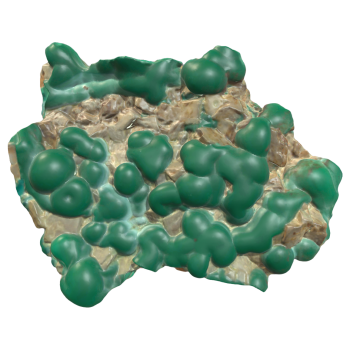
Malachite
Malachite is a carbonate mineral mainly composed of Cu2 (OH) 2CO3, with a color ranging from dark green to bright green, silky or glassy luster, semi transparent to opaque, and a Mohs hardness of 3.5-4.5. Malachite is produced on the surface of copper mines, near the surface oxidation zone, and coexists with chalcopyrite, azurite, chalcopyrite, and siliceous malachite. It is an important mineral for prospecting primary copper mines and also a type of jade material.

lapis lazuli
Lazurite is a framework silicate mineral containing sulfate ions, sulfur ions, and chloride ions. Its chemical formula is (Na, Ca) 8 [(S, Cl, SO4, OH) 2 | (Al6Si6O24)]. Belonging to the feldspar like mineral group of sodalite minerals, the crystal system is equiaxed, and intact crystal forms are extremely rare, mostly in the form of blocks. Most of them exist in Qingjin Rock in nature. The English word 'Lazrite' comes from the Persian word 'lazward', which means blue.

Green curtain stone amphibolite
Green mud amphibolite schist is a metamorphic rock formed by regional metamorphism, including basalt, tuff, gabbro, diabase, and other rocks. It represents a metamorphic environment of about 500-600 degrees Celsius and a pressure of less than ten kilobars. Its main minerals are chlorite and amphibole, with amphibole content greater than 40%. It may also contain small amounts of minerals such as plagioclase, epidote, biotite, pyrite, etc. Green mudstone, dark green in color, carved into small pieces with a small knife to appear light green, extremely fine and scaly. Hornstone schist is a common rock in orogenic belts and ancient metamorphic terrains, and is a characteristic feature of regional metamorphic amphibolite facies.

Chromite ore
Chromite is a mineral formed by magmatic processes, often occurring in ultrabasic rocks and coexisting with olivine; Also found in sand mines. It looks very similar to magnetite in appearance, usually in the form of block or granular aggregates. In the metallurgical industry, chromite is mainly used to produce ferrochrome alloys and metallic chromium. Chromium iron alloy is used as an additive to produce various high-strength, corrosion-resistant, wear-resistant, high-temperature resistant, and oxidation resistant special steels. Chromium metal is mainly used for smelting special alloys with elements such as cobalt, nickel, and tungsten. Chromite is a scarce mineral with limited reserves and low production. In industry, similar minerals such as chromite, chromite spinel, rich chromite spinel, and hard chromite spinel are often collectively referred to as chromite.

Chloride silver ore
Chlorargyrite, with a chemical composition of AgCl and a molecular weight of 143.32. The production environment is in a partially oxidized silver deposit, with colors of purple gray, green, white, and colorless. Chlorite can be used as a mineral raw material for extracting silver.

Arsenic ore
A non-metallic mineral primarily composed of arsenic sulfide. Arsenic has three allotropes: yellow, gray, and black brown. Its gray crystals are metallic, brittle, and hard. The main minerals are realgar, orpiment, and arsenopyrite; Arsenic is the main component, with a cut-off grade of 5% for the former and 3-5% for the latter; The industrial grade is 10% for the former and 5% to 6% for the latter. There are also arsenic nickel ore, arsenic antimony ore, arsenic pyroxene, orthorhombic arsenic iron ore, etc. Generally, underground mining method is used for mining, and flotation method is used for beneficiation.

Silver sulfide ore
The chemical composition is Ag2S, containing 87.1% Ag. Isometric. The crystal is cubic or octahedral, usually in the form of dense blocks. The color and stripes are both lead gray. The fresh fracture surface has a metallic luster. Mohs hardness is 2-2.5. Density 7.2-7.4. Has weak extensibility. It is a mineral of hydrothermal origin, formed above 173 ℃. Below this temperature, it transforms into spiral shaped sulfide silver with the same composition. It is a mineral raw material for silver smelting, but the main source of silver is obtained as a by-product from copper lead zinc ores.

Wenshi mineral
Wenshi is a carbonate mineral. The component is CaCO3. Also known as aragonite, it is homogeneous and resembles calcite and other minerals. The rhombohedral system is characterized by columnar or lance shaped crystals, commonly exhibiting pseudo hexagonal symmetry in three connected crystals. Collectives are often in the form of shells, concretions, beans, spherical particles, etc. Usually white or yellow white in color. Glass gloss, with a grease gloss on the fracture surface. Incomplete cleavage of the board surface. Shell shaped fracture. Mohs hardness is 3.5-4.5. The specific gravity is between 2.9 and 3.0. In nature, aragonite is unstable and often transforms into calcite. Mainly formed under exogenous conditions, occurring in modern seabed sediments or clay; In limestone caves.

Popular Models


Random Model
3D animation of Manx cat cub model
867 View


Black folder with files
720 View

Balinese Women Wood Carvings
720 View

Nintendo Game Boy (yellow)
878 View
Collie Shepherd (Clay)
1095 View
UV-irradiated ruby
842 View
Bedside table
1023 View
MARTA CQ312 Italy Metro Train
989 View

Ancient Japanese temples
1773 View